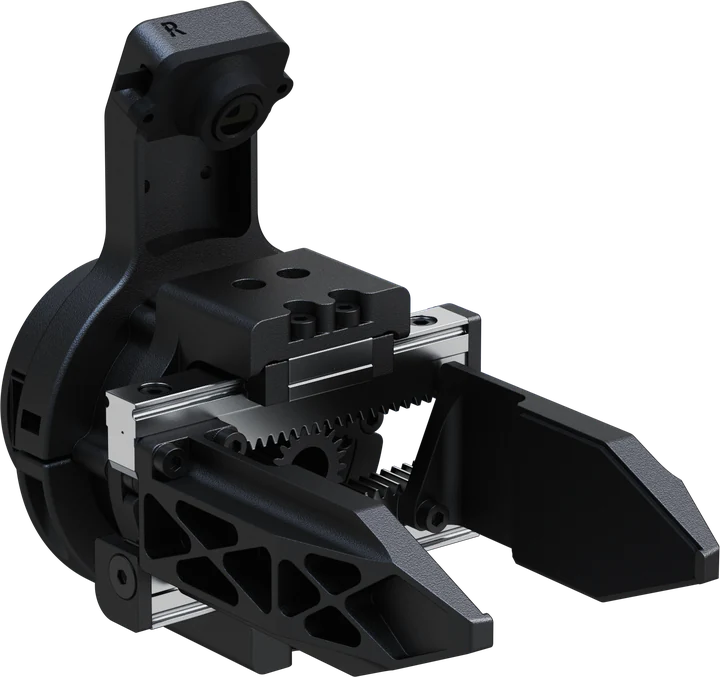
Dex1-1 Advanced
- Form
- Parallel gripper
- Hand motion
- Parallel jaw motion
- Sensing
- No tactile feedback
- Size reference
- 90 mm jaw stroke
- Control interface
- High-speed 485
Offered on R1, G1 and H2 EDU packages.
Explore this option
HAND SELECTION GUIDE
Compare five gripper and hand options for R1, G1 and H2 EDU by grasp, control and sensing.
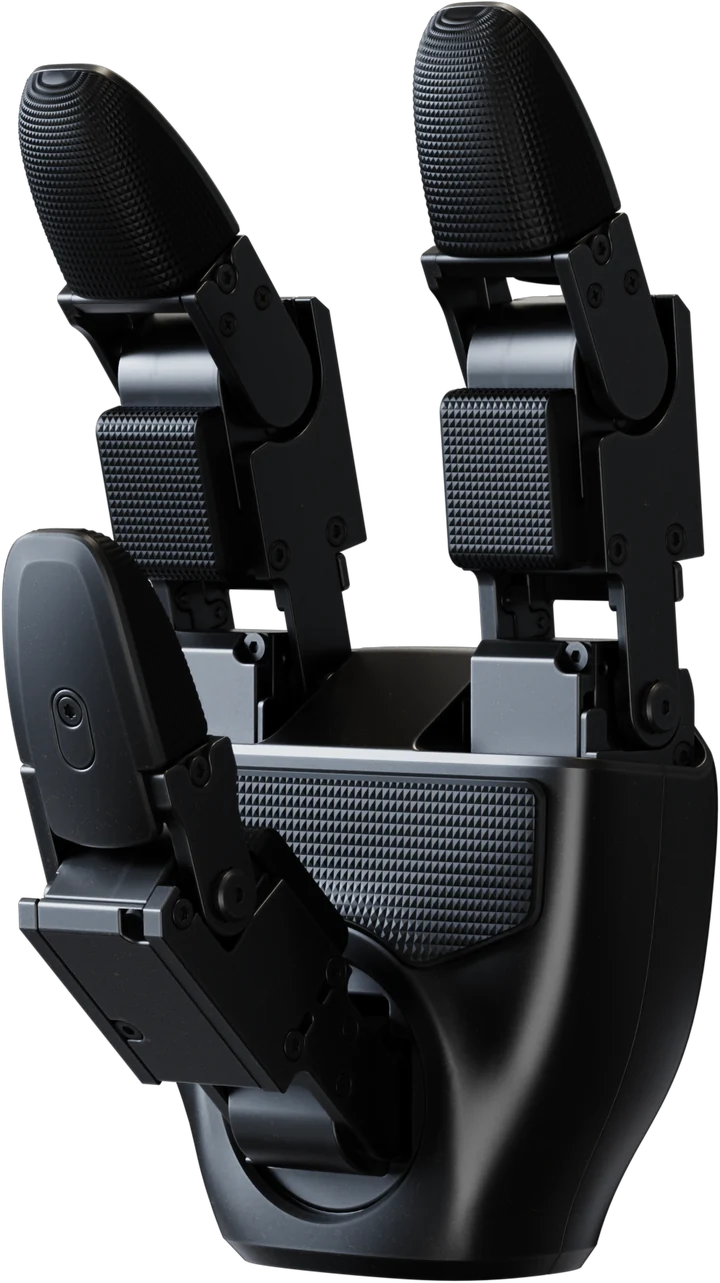
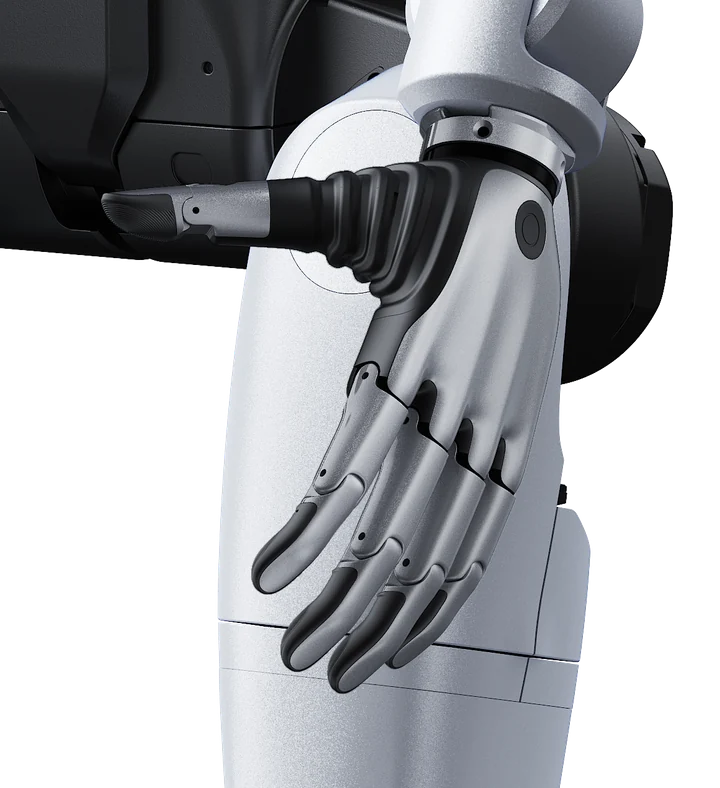
Compare the optionsManufacturer imagery. Dex3 tactile model pictured; Revo 2 Basic/Touch variant is unspecified. Images are not to scale.
01 / START WITH THE TASK
Use this as a starting point for evaluation, then test with your actual objects and software.
A STARTING POINT
Dex1-1 Advanced is a candidate when the object has accessible opposing grasp surfaces. Check jaw clearance, friction and release before assuming a grasp will work.
Explore Dex1-1 Advanced02 / SIDE BY SIDE
Geometry and sensing are useful distinctions. A bigger number of fingers is not a universal performance ranking.
Showing all five options.
| What matters | Parallel gripperDex1-1 AdvancedExplore | Three-fingerDex3-1 StandardExplore | Three-fingerDex3-1 TactileExplore | Five-fingerRevo 2 BasicExplore | Five-fingerRevo 2 TouchExplore |
|---|---|---|---|---|---|
| Form | Parallel gripper | Three-finger | Three-finger | Five-finger | Five-finger |
| Hand motion | Parallel jaw motion | 7 degrees of freedom | 7 degrees of freedom | 6 DOF / 11 joints | 6 DOF / 11 joints |
| Sensing | No tactile feedback | No tactile feedback | 33 pressure sensors | No tactile feedback | Pressure, friction, direction & proximity feedback |
| Size reference | 90 mm jaw stroke | 175 × 88 × 77 mm | 175 × 88 × 77 mm | 160 mm fingertip to palm base | 160 mm fingertip to palm base |
| Control interface | High-speed 485 | USB | USB | Confirm for your integration | Confirm for your integration |
| Robot packages | R1 / G1 / H2 EDU | R1 / G1 / H2 EDU | R1 / G1 / H2 EDU | R1 / G1 / H2 EDU | R1 / G1 / H2 EDU |
Offered on R1, G1 and H2 EDU packages.
Explore this optionOffered on R1, G1 and H2 EDU packages.
Explore this optionOffered on R1, G1 and H2 EDU packages.
Explore this optionOffered on R1, G1 and H2 EDU packages.
Explore this optionOffered on R1, G1 and H2 EDU packages.
Explore this optionRead the measurements in context. Dex1 lists jaw stroke; Dex3 lists overall dimensions; Revo 2 lists fingertip-to-palm length. These measure different things.
Robot packages include a pair of hands. Final equipment is confirmed in your quote.
DOF means degrees of freedom. Interface details and final package compatibility are confirmed for your project. Specifications below are manufacturer references, not measured results from your task.
Two-jaw gripping for known objects with accessible opposing surfaces.
Adjustable gripping force: 5–120 N. Force depends on control settings and operating conditions.
Configure Dex1-1 Advanced on
Robot prices are for the Dex1-1 Advanced base package. The hand selected here is quoted with your configuration.
Test your smallest and largest objects, slippery surfaces, approach clearance, acceleration and clean release.
Three-finger grasping with coordinated finger motion and optional tactile sensing.
Seven degrees of freedom: three in the thumb, two in each of the other two fingers.
Configure Dex3-1 Standard on
Robot prices are for the Dex1-1 Advanced base package. The hand selected here is quoted with your configuration.
Test fingertip access, stable contact on your actual objects, joint limits and the feedback available through your software.
A five-finger layout for human-style grasp and teleoperation research.
Six degrees of freedom across eleven joints. Finger count and independently controlled motion are different specifications.
Configure Revo 2 Basic on
Robot prices are for the Dex1-1 Advanced base package. The hand selected here is quoted with your configuration.
Try representative grasp poses, thumb access, object release and the command mapping used by your operator or controller.
03 / SEE THE WORKFLOW
Watch the approach, contact and release—not just the successful lift.
These Unitree demonstrations show manipulation workflows. Exact hand variants are not established by the source files; the clips are not demonstrations of every option above.
Manufacturer factory demonstration. Look at how the robot approaches the object and clears the work surface.
Silent excerpt. Manufacturer footage shown at 2× speed; excerpt not further retimed.
A G1 robot handles parts at a factory workstation. The camera shows its arm and hand positioning, object contact and placement. The source includes sped-up footage; this is not a cycle-time benchmark.
Manufacturer teleoperation demonstration. Observe the reach, object orientation and coordinated arm movement.
Silent excerpt. Operator-controlled workflow; shown hands and software may differ.
A G1 robot handles objects in a kitchen-like setting during a teleoperation demonstration. The operator controls the workflow. The clip illustrates manipulation context, not autonomous task performance or a verified hand-variant comparison.
04 / BEFORE YOU CHOOSE
No. Tactile sensing supplies contact information. Your control software must read, interpret and act on that information. It does not supply a finished grasping application.
Fingers, joints and independently controlled motions are different counts. Revo 2 lists six degrees of freedom across eleven joints. Dex3-1 lists seven degrees of freedom across three fingers. Choose around the motions your task requires.
No. Hand tests and robot arm limits describe different things. Useful load depends on the complete robot, hand, object, contact geometry, orientation and motion. For example, a form-fitting gripper test does not establish what a humanoid arm can carry.
The options here map to the current EDU factory packages offered by Thetic. This does not establish that an arbitrary existing robot can accept the hand as a plug-in upgrade. Mounting, wiring, controllers and software should be reviewed together.
That depends on the robot package. R1 and H2 package sheets list wrist RGB cameras for the five options shown here. The checked G1 sheet explicitly lists a camera for its Dex1-1 Advanced package; it does not establish camera inclusion for the other four options. Your quote confirms the equipment.
Describe the objects, size and mass range, surface materials, workspace, required grasp poses, movement speed, sensing needs and software you plan to use. Photos or examples of the task help define what should be tested. Keep the initial inquiry nonconfidential.
PLAN THE APPLICATION
Technical references: Unitree hand brochures and EDU configuration sheets, April–October 2026. Buyer-fit guidance is based on hand geometry and stated controls; validate performance on your actual task.